Modern Christians often read the New Testament as though Jesus and the apostles were standing in a relatively ordinary world while describing catastrophic events thousands of years in the future.
That assumption deserves to be challenged.
The first-century Jewish world was already coming apart.
Jesus was born into a people who had endured centuries of conquest, foreign domination, cultural assimilation, failed revolts, competing claims to religious authority, and growing expectations that God would finally intervene and restore Israel.
As discussed previously in Jesus Arrived at Israel’s Last Hour, Jesus did not enter a flourishing independent nation temporarily inconvenienced by Roman occupation. He entered a culture struggling to preserve its identity after centuries under Babylonian, Persian, Greek, and finally Roman rule.
And as explored in Why Resurrection Was Israel’s National Hope, Israel’s expectation was not merely about individual people going to heaven after death. It was about restoration: covenant, land, kingship, vindication, resurrection, and the hope that God would finally set His people right.
Those two realities provide the backdrop for something modern readers frequently underestimate:
The New Testament emerged from a Jewish world shaken by Roman rule, mounting conflict, and the destruction of Jerusalem.
The warnings about wars, revolts, false prophets, persecution, betrayal, famine, Jerusalem surrounded by armies, and catastrophic judgment were not spoken into an historical vacuum.
The people hearing them were already standing on a fault line.
That does not mean Judea experienced uninterrupted chaos, or that war was inevitable. Josephus could describe Jerusalem as peaceful and prosperous only a few years before the revolt. Political fragility and ordinary life existed together. The catastrophe grew out of particular decisions, abuses, conflicts, and failed attempts at peace—not a people’s inability to survive. See Josephus, Jewish War 6.5.3.
We should also distinguish the events described from the dates when the books were written. Paul’s earliest letters precede AD 70; the dating of other New Testament writings is debated, and many scholars place several Gospels and other books after Jerusalem’s destruction. This article reconstructs the world behind the texts; it does not require every book to have been completed before AD 70. For a representative discussion of later datings, see Yale Bible Study’s overview.
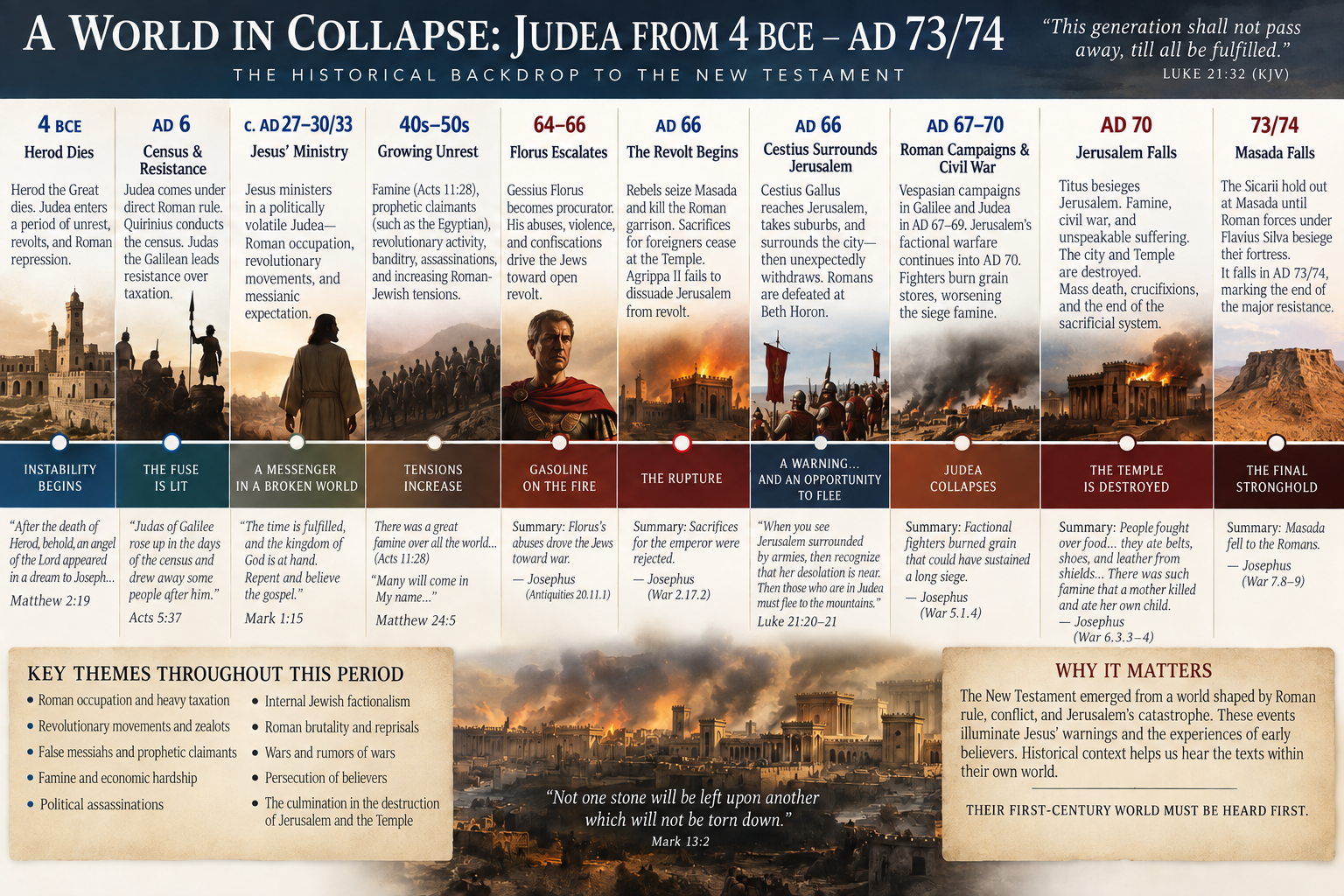
AD 6 — The Political Fuse Is Lit
One of the most important dates for understanding the world behind the New Testament is AD 6.
Judea came under direct Roman administration, and Publius Sulpicius Quirinius conducted the census associated with Roman taxation.
The response was not peaceful.
Josephus tells us that Judas the Galilean led resistance against Roman taxation, linking liberty with God’s exclusive lordship. See Antiquities 18.1.1, 18.1.6.
Luke remembers the same figure:
“Judas of Galilee rose up in the days of the census and drew away some people after him.”
— Acts 5:37
That little historical reference is more important than it initially appears.
Josephus later connects the ideological stream associated with Judas with the radical resistance movements that ultimately contributed to the Jewish revolt.
The political question therefore existed decades before Jerusalem burned:
If God alone is Israel’s King, how far can Israel submit to Caesar?
Jesus entered precisely this world.
Jesus Was Preaching Into a Pressure Cooker
When Jesus announced,
“The time is fulfilled, and the kingdom of God is at hand; repent and believe in the gospel.”
— Mark 1:15
His audience did not hear the phrase kingdom of God in a political vacuum.
Rome occupied the land.
Herodian rulers governed under Roman authority.
Taxes were deeply resented.
Memories of the Maccabean revolt remained culturally powerful.
Messianic hopes were intense.
Different Jewish movements were proposing very different answers to the question of Israel’s survival.
Some emphasized strict Torah observance.
Some withdrew.
Some accommodated Rome.
Others increasingly embraced resistance.
Jesus offered another path entirely.
He proclaimed the arrival of God’s reign while simultaneously warning Israel that its present trajectory would end catastrophically.
That is why His lament over Jerusalem matters:
“If you had known in this day, even you, the things which make for peace! But now they have been hidden from your eyes.”
— Luke 19:42
Then He becomes disturbingly specific:
“For the days will come upon you when your enemies will throw up a barricade against you, and surround you and hem you in on every side.”
— Luke 19:43
Within approximately forty years, that happened.
The 40s and 50s — Instability Becomes Normal
The decades after Jesus were not peaceful years waiting for some distant prophetic clock to begin ticking.
Josephus describes increasing instability throughout Judea.
Banditry grew.
Revolutionary movements appeared.
Assassinations became part of political life.
Men claiming prophetic authority gathered followers around promises of divine intervention.
One particularly famous figure was known simply as the Egyptian.
Josephus describes him gathering followers and leading them toward the Mount of Olives with promises connected to Jerusalem. See Jewish War 2.13.4–5. The accounts in Josephus and Acts differ in their numbers and details; their overlap should not be mistaken for exact agreement.
Acts also preserves a memory of how notorious this man had become.
When Paul is arrested in Acts, the Roman commander asks:
“Then you are not the Egyptian who some time ago stirred up a revolt and led the four thousand men of the Assassins out into the wilderness?”
— Acts 21:38
That exchange is easy to skim past.
But it tells us something extremely important about the social environment of Acts.
Roman officials were actively concerned about revolutionary leaders gathering armed followers.
Now reconsider Jesus’ warning:
“Many will come in My name…”
“You will be hearing of wars and rumors of wars…”
“Many false prophets will arise…”
— Matthew 24:5–6, 11
These statements should first be heard within that world.
Before we transport them thousands of years forward, we should ask what they sounded like to people watching revolutionary movements, prophetic claimants, political assassinations, and Roman reprisals unfold around them.
Famine Was Not Merely Prophetic Language
The first century also experienced severe food shortages.
Acts records prophets warning that:
“There would certainly be a great famine all over the world.”
— Acts 11:28
Josephus independently describes a severe famine in Judea during the reign of Claudius.
Queen Helena of Adiabene responded by purchasing grain from Egypt and dried figs from Cyprus for the starving population. See Antiquities 20.2.5.
This matters because when modern readers encounter Jesus speaking of famines, we often instinctively treat the word as an item on an end-times checklist.
The communities described in Acts did not have to imagine what famine looked like.
They experienced it.
AD 64–66 — Florus Pushes Judea Toward Revolt
By the mid-60s, the situation deteriorated rapidly.
Gessius Florus became Roman procurator of Judea.
Even Josephus—hardly sympathetic toward the Jewish revolutionaries—places enormous blame on Florus for escalating the conflict. See Antiquities 20.11.1.
Florus’s abuses, violence, provocations, and handling of Jerusalem helped transform longstanding resentment into open revolt.
By AD 66, the rupture had come.
Rebels captured Masada and killed its Roman garrison.
Eleazar son of Ananias persuaded those officiating in the Temple to refuse gifts and sacrifices for foreigners, including the customary sacrifice for the emperor. See Jewish War 2.17.2.
Josephus regarded this decision as a decisive break with Rome.
Agrippa II attempted to persuade Jerusalem to abandon the rebellion.
He failed.
The war had begun.
AD 66 — Jerusalem Is Surrounded
Then something happened that should immediately attract the attention of anyone reading Luke 21.
The Roman governor of Syria, Cestius Gallus, marched against Jerusalem.
His army reached the city.
Roman forces attacked its defenses and penetrated portions of Jerusalem.
Josephus believed Cestius could have taken the city.
And then, unexpectedly, he withdrew.
Josephus himself seems astonished by the decision, saying Cestius withdrew:
“without any reason in the world.”
— Josephus, Jewish War 2.19.7, William Whiston translation
The retreat turned into a Roman disaster.
Jewish forces pursued Gallus and inflicted a humiliating defeat on the Roman army near Beth Horon.
Now read Jesus again:
“But when you see Jerusalem surrounded by armies, then recognize that her desolation is near. Then those who are in Judea must flee to the mountains.”
— Luke 21:20–21
Jerusalem was surrounded by Roman armies in AD 66.
And then the army withdrew.
There was suddenly an opportunity to leave before the final Roman campaign.
That correspondence deserves serious attention.
It does not require claiming that Josephus somehow “proves” Luke, nor should every historical event be forced into a prophetic verse.
But neither should the sequence be ignored simply because modern Christian traditions have trained readers to expect these events primarily in our own future.
Later Christian tradition preserved by Eusebius reports that the Jerusalem church was instructed before the war to leave for Pella. Writing centuries later, Eusebius does not establish that this departure followed Gallus’s withdrawal. That connection remains an inference, not a detail supplied by his account. See Church History 3.5.3.
Whether every detail of that later tradition can be reconstructed with certainty is another matter.
The larger historical point remains:
Jerusalem was surrounded, Rome withdrew, and the final destruction had not yet begun.
AD 67–70 — Campaigns and Civil War
Rome returned under Vespasian.
His strategy was methodical.
Rather than immediately throwing Roman forces against Jerusalem, Vespasian systematically crushed resistance throughout Galilee and Judea.
Town after town fell.
Refugees and revolutionaries poured toward Jerusalem.
And inside the city, the situation became increasingly grotesque.
Jerusalem’s armed factions were no longer merely fighting Rome.
They were fighting one another.
By early AD 70, Jerusalem contained competing armed factions associated with leaders such as John of Gischala, Simon bar Giora, and Eleazar son of Simon.
Josephus portrays Jerusalem as descending into internal warfare while the Roman army closed around it.
Men who supposedly shared the same Temple, Scriptures, ancestry, and national enemy began killing one another.
And then they did something almost unbelievable.
They burned their own food.
Josephus records that factional fighters set fire to houses containing grain and provisions in the period immediately preceding Titus’s siege. The passage belongs to his account of early AD 70, rather than securely to AD 67–69. See Jewish War 5.1.4.
He believed the stored food could have sustained Jerusalem for years.
Instead, Jewish factions destroyed much of it themselves.
Rome had not yet starved Jerusalem.
Jerusalem helped create its own famine.
Now listen again to the language of Jesus:
“Brother will betray brother to death…”
— Mark 13:12
In Mark 13:9–13, the immediate subject is the persecution of Jesus’ followers, including betrayal within families. Jerusalem’s factional warfare illustrates the wider atmosphere of conflict; it should not replace the passage’s own subject or be presented as proof of its fulfillment.
The point is that persecution and betrayal belonged to the real world of the earliest believers.
Within the lifetime of His audience, Judea descended into betrayal, factional hatred, revolutionary violence, and civil conflict.
AD 70 — The Great Catastrophe
Then Titus arrived.
Jerusalem was surrounded again.
This time Rome did not leave.
The city was packed with people, including pilgrims who had entered Jerusalem around Passover.
Roman siege works tightened around the city.
Food disappeared.
And Josephus’s account becomes horrifying.
He describes people fighting over scraps of food.
Children pulled food from their fathers.
Mothers took food from their infants.
Armed men invaded homes because they suspected someone might have something left to eat.
Eventually normal food was gone.
People ate things no one would ordinarily regard as food.
Belts were chewed.
Shoes were eaten.
Josephus says people stripped the leather from their shields and gnawed on it.
Old hay and plant fibers became valuable commodities.
People searched refuse and filth hoping to find something edible.
Josephus records one of the most disturbing stories in ancient historiography: Mary daughter of Eleazar, suffering extreme hunger and abuse, killed and ate part of her own infant son. This is Josephus’s report, not an independently verified incident; its place in his portrayal of the siege should be made clear. See Jewish War 6.3.3–4 for this account and the preceding description of people eating leather.
Josephus himself expresses reluctance to record it.
That was Jerusalem in AD 70.
Crucifixions Surrounded the City
The horror was not confined within Jerusalem’s walls.
People attempting to escape the city were captured by Roman forces.
Josephus reports that Roman forces captured five hundred people a day, and sometimes more, in the episode where he describes prisoners being tortured and crucified outside Jerusalem. See Jewish War 5.11.1.
Roman soldiers varied the position of the victims for amusement.
Eventually, Josephus says, there was effectively not enough room for the crosses or enough crosses for the bodies.
Ancient numerical claims should always be handled carefully. Josephus was a participant in the war who later wrote under Roman imperial patronage. His testimony is indispensable, but his allocation of blame, speeches, and dramatic details require critical reading. See L. Michael White’s discussion of Josephus as a source.
But we do not need perfect casualty statistics to grasp what happened.
The landscape around Jerusalem had become a killing field.
Inside the city were starvation, disease, murder, and civil war.
Outside were Roman legions and crucifixions.
Now read Jesus’ words without immediately projecting them into the twenty-first century:
“For then there will be a great tribulation, such as has not occurred since the beginning of the world until now…”
— Matthew 24:21
Or Luke:
“There will be great distress upon the land and wrath to this people.”
— Luke 21:23
Notice Luke’s wording carefully.
In this passage, the immediate focus is Jerusalem, Judea, and their people.
Wrath upon “this people.”
He continues:
“They will fall by the edge of the sword, and will be led captive into all the nations; and Jerusalem will be trampled under foot by the Gentiles…”
— Luke 21:24
That sounds considerably less mysterious after reading Josephus. This local focus does not, by itself, settle every question about the rest of the discourse.
The Temple Burns
In AD 70, Roman forces finally penetrated Jerusalem.
The Temple burned.
Sacrificial worship at the Jerusalem Temple ceased.
The priestly Temple-centered order around which Jewish national life had revolved for centuries collapsed.
Jesus’ disciples had once admired the Temple complex:
“Teacher, behold what wonderful stones and what wonderful buildings!”
— Mark 13:1
Jesus answered:
“Do you see these great buildings? Not one stone will be left upon another which will not be torn down.”
— Mark 13:2
For the people standing there listening to Him, this was not an abstract theological metaphor.
That building was standing in front of them.
And within their generation it was destroyed.
Their city fell.
Their Temple burned.
Their priestly order was shattered.
Their political world collapsed.
Those of Jesus’ hearers who lived to AD 70 did not need to wait two thousand years to see Jerusalem’s destruction.
They watched it happen.
AD 73/74 — Masada and the End of the Revolt
Jerusalem’s destruction did not immediately end every pocket of resistance.
Masada had been seized by Jewish rebels near the beginning of the revolt in AD 66.
After Jerusalem fell, it remained one of the final strongholds.
Roman forces under Flavius Silva eventually surrounded and besieged the fortress around AD 73/74.
Its fall marked the defeat of the revolt’s last major fortress in Judea. See Jewish War 7.8–9.
The historical trajectory is sobering:
AD 6 — Quirinius’s census; Judas the Galilean resists Rome
Late 20s–early 30s — Jesus ministers in Galilee and Judea under Roman imperial rule
40s–50s — famine, prophetic claimants, revolutionary activity, assassinations, and unrest increase
AD 64–66 — Florus accelerates the crisis
AD 66 — revolt begins; Masada is seized; Temple sacrifices for foreigners cease
AD 66 — Cestius Gallus surrounds Jerusalem, unexpectedly withdraws, and suffers defeat
AD 67–69 — Vespasian campaigns in Galilee and Judea; Jerusalem descends into factional warfare
Early AD 70 — Competing factions burn Jerusalem’s grain stores before Titus’s siege
AD 70 — Titus besieges Jerusalem; famine devastates the population; Jerusalem and the Temple are destroyed
AD 73/74 — Masada falls
That is the historical world surrounding the New Testament.
The Authors Were Not Writing From Our World
This is where the hermeneutical problem becomes important.
Modern readers encounter words such as:
tribulation
apostasy
wars
famines
persecution
false prophets
lawlessness
judgment
and instinctively begin scanning modern headlines.
But Jesus and the apostles were not speaking first to us.
They were speaking to people living there.
Paul wrote to churches while Judea was becoming increasingly unstable.
James wrote into a Jewish-Christian environment shaped by oppression and social tension.
Peter addressed believers experiencing hostility and suffering.
Luke wrote about revolutionary figures his readers already knew.
The author of Hebrews addressed believers through Israel’s Scriptures and priestly traditions; the date and precise identity of that audience remain debated.
And Jesus had explicitly warned His own generation that Jerusalem was approaching catastrophe. The churches also lived in different places and circumstances; events in Judea illuminate their world without explaining every problem addressed in every letter.
Therefore the first question cannot be:
“How does this fit our end-times chart?”
The first question must be:
“What would these words have meant to the people who originally received them?”
That does not mean every New Testament eschatological expectation was exhausted in AD 70.
I do not believe it was.
The bodily return of Christ remains future.
The resurrection of those who belong to Him remains future.
The defeat of death remains future.
Judgment and the renewal of creation remain future.
Partial preterism is not the claim that everything already happened.
It is the recognition that much of the New Testament’s language of approaching judgment makes considerably more sense when we stop removing it from the collapsing first-century Jewish world in which it was actually spoken.
It Was the End of Their World
This is perhaps the distinction modern readers miss most often.
When we hear apocalyptic language, we instinctively think:
the end of planet Earth.
Ancient Jewish prophetic literature frequently spoke differently.
The collapse of kingdoms, rulers, cities, and political worlds could be described using cosmic language. Isaiah’s oracle concerning Babylon invokes darkened heavenly lights (Isaiah 13:1, 10), while Ezekiel’s lament over Pharaoh does the same (Ezekiel 32:2, 7–8). These precedents matter, even though each later passage still needs to be read on its own terms.
Sun and moon darkened.
Stars fell.
Heavens shook.
The world turned upside down.
That imagery did not make the events less real.
It made them more significant.
Jerusalem’s destruction in AD 70 was not merely another city losing another war.
For first-century Judaism, the Temple represented the center of the covenant world.
Priests served there.
Sacrifices were offered there.
Pilgrimage festivals centered there.
National identity revolved around it.
The Jewish people survived AD 70.
Judaism survived AD 70.
But the Temple-centered world inherited from Israel’s Scriptures did not.
And that is why Jesus’ warnings carried such urgency.
Before asking whether He was describing the end of our world, we should first reckon seriously with the fact that His generation witnessed the end of theirs.
That historical setting does not answer every eschatological question.
But it changes the questions we are permitted to ask.
Because once we stop reading the New Testament as though its authors were sending coded messages primarily to twenty-first-century Christians, the texts become startlingly concrete.
They were speaking to real churches.
Living under real rulers.
Facing real persecution.
Watching real revolutionary movements.
Experiencing real famine.
Hearing real rumors of war.
Some wrote as Jerusalem’s destruction approached. Others, on commonly proposed datings, wrote in its aftermath. The catastrophe belongs to their historical world in either case.
The New Testament did not emerge from a tranquil world untouched by the crises its pages describe.
Its earliest witnesses lived through the pressures that would shatter Jerusalem’s Temple-centered world.
For the larger historical background to this discussion, see RAF’s earlier studies Jesus Arrived at Israel’s Last Hour and Why Resurrection Was Israel’s National Hope. Together, these articles trace the cultural fragility, restoration expectations, and first-century crisis necessary for reading the New Testament within its own world.
Omnia in Christo.
Sources and Reading Notes
Josephus references use book, chapter, and section numbering in William Whiston’s translation. His historical reports are distinguished above from the article’s partial-preterist interpretation. The timeline’s Josephus summaries are paraphrases, and its illustrations are artistic reconstructions.
Before the revolt: Antiquities 18.1.1, 18.1.6 (Judas and taxation); 20.2.5 and 20.11.1 (Helena’s famine relief and Florus); Jewish War 2.13.3–5, 2.17.2, 2.19.7–9 (unrest, the break with Rome, and Gallus).
Jerusalem’s siege: Jewish War 5.1.4, 5.10.3, 5.11.1 (grain stores, hunger, and crucifixions); 6.3.3–4 and 6.4 (extreme famine and the Temple’s burning).
Pella and Masada: Eusebius, Church History 3.5.3; Josephus, Jewish War 7.8–9. These are separate traditions and events.
 Restoring Apostolic Faith
Leave a comment