Many Christians open their Bibles and move directly from Malachi to Matthew as though nothing happened in between.
But nearly four centuries separate the last prophets of the Old Testament from the birth of Jesus.
Often called the “silent years” — however they were anything but silent. This period was one of the most important eras in Jewish history.
Empires rose and fell.
Languages changed.
The temple was desecrated and rededicated.
Jewish sects emerged.
Messianic expectations intensified.
By the time Jesus was born, the world of Abraham, Moses, and David had changed dramatically.
If we ignore these centuries, we risk reading the New Testament as though it appeared in a vacuum.
It did not.
Jesus was born into a world already shaped by four hundred years of political upheaval, theological reflection, and cultural conflict.
A timeline for the world behind the Gospels
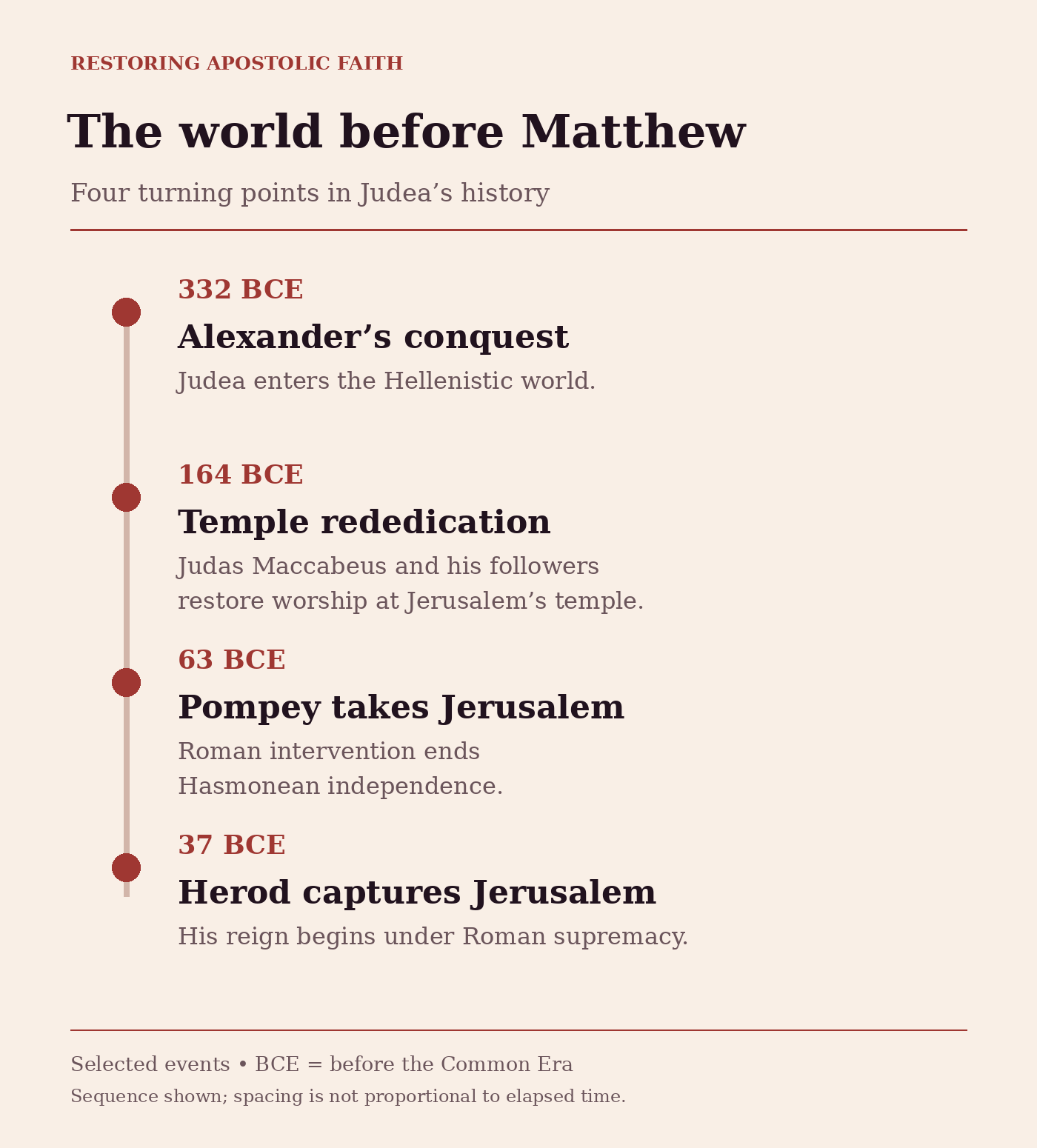
The sequence moves from Alexander’s conquest in 332 BCE to the temple rededication in 164 BCE, Pompey’s capture of Jerusalem in 63 BCE, and Herod’s capture of the city in 37 BCE. These landmarks sit within a longer history of Persian, Ptolemaic, Seleucid, Hasmonean, and Roman power.
Sources: Judea chronology; 1 Maccabees 4:36–59 on the rededication.
From Persia to Greece
When the Old Testament closes, the Jews lived under Persian rule.
Persian rule in Judea gave way to Alexander’s conquest in 332 BC. His wider campaigns helped spread Greek power and culture across the Near East.
Greek language, philosophy, education, and customs spread across the Near East in a process historians call Hellenization.
By the first century, Greek had become the common language of much of the Mediterranean world, which helps explain why the New Testament was written in Greek rather than Hebrew.¹
N. T. Wright notes:
“The world into which Jesus was born had been transformed by the conquests of Alexander and the spread of Hellenistic culture.”²
This Greek influence created both opportunities and tensions for Jewish communities trying to preserve their covenant identity.
The Septuagint Changed the Jewish World
As many Jews became dispersed throughout the Mediterranean, not all continued speaking Hebrew fluently.
In Alexandria, Egypt, Jewish scholars translated the Hebrew Scriptures into Greek.
This translation became known as the Septuagint (LXX).
By the first century, many Jews—and eventually many Christians—used the Septuagint as their primary Scriptures.³
The New Testament frequently quotes the Old Testament in forms that align more closely with the Septuagint than with the later Masoretic Text.⁴
Understanding this fact helps explain why some New Testament quotations differ from modern English Bibles.
Antiochus IV and the Maccabean Revolt
One of the most traumatic events in Jewish history occurred under Antiochus IV Epiphanes (r. 175–164 BC).
Ancient sources report that Antiochus attempted to suppress Jewish practices, outlaw circumcision, and desecrate the Jerusalem temple.⁵
The books of 1 and 2 Maccabees preserve many of these events.
In response, the priestly family of the Hasmoneans—often called the Maccabees—led a revolt against Seleucid rule.
The temple was eventually purified and rededicated in 164 BC.
This event is still commemorated today as Hanukkah (John 10:22).
The trauma of foreign oppression deeply shaped Jewish expectations of deliverance and contributed to later hopes for a coming Messiah.⁶
The Rise of Resurrection Hope
During this period, Jewish thought concerning resurrection became increasingly prominent.
Earlier biblical texts contain hints of resurrection hope (Isaiah 26:19; Daniel 12:2), but Second Temple literature often develops these themes more explicitly.
The martyr narratives in 2 Maccabees repeatedly express confidence that God will raise the righteous dead.⁷
As scholar N. T. Wright argues:
“Resurrection was not about escaping the world but about God’s future renewal of it.”⁸
This expectation forms essential background for understanding Jesus, Paul, and the earliest Christians.
The Birth of Jewish Sects
By the time of Jesus, Judaism was not monolithic.
Several major groups had emerged:
Pharisees
The Pharisees emphasized Torah observance, oral tradition, resurrection, and purity practices. Josephus describes them as highly influential among the people.⁹
Sadducees
The Sadducees were closely associated with the priestly aristocracy and rejected certain beliefs accepted by the Pharisees, including resurrection (Acts 23:8).¹⁰
Essenes
Many scholars associate the Essenes with the Dead Sea Scroll community at Qumran, though the identification remains debated.¹¹
Zealots
Various revolutionary movements longed for liberation from foreign rule and anticipated divine intervention against Rome.¹²
Understanding these groups helps explain many of the theological disputes found in the Gospels.
The Dead Sea Scrolls Opened a Window into Jesus’ World
Discovered beginning in 1947 near Qumran, the Dead Sea Scrolls revolutionized our understanding of Second Temple Judaism.
The scrolls reveal a world filled with:
- messianic expectation,
- apocalyptic hope,
- concerns about purity,
- angelic language,
- and covenant renewal.
As Geza Vermes famously observed, the scrolls provide “a library from the age of Jesus.”¹³
They do not prove Christianity.
But they do demonstrate that many ideas appearing in the New Testament were already circulating within Jewish thought before the birth of Christ.
Why This Matters
The New Testament did not emerge from nowhere.
Jesus entered a world shaped by exile, empire, resistance, and hope.
The Jews of the first century were not merely waiting for souls to go to heaven.
They were waiting for God to act.
They longed for restoration.
For deliverance.
For resurrection.
For the kingdom.
When Jesus announced:
“The kingdom of God is at hand” (Mark 1:15, NASB),
His audience already carried centuries of expectations.
Understanding the world between Malachi and Matthew does not diminish Scripture.
It illuminates it.
The better we understand their world, the more clearly we hear the words of Jesus in their original setting.
Notes
- Martin Hengel, Judaism and Hellenism (Philadelphia: Fortress Press, 1974), 1:104–106.
- N. T. Wright, The New Testament and the People of God (Minneapolis: Fortress Press, 1992), 147.
- Karen H. Jobes and Moisés Silva, Invitation to the Septuagint, 2nd ed. (Grand Rapids: Baker Academic, 2015), 29–48.
- Richard B. Hays, Echoes of Scripture in the Gospels (Waco, TX: Baylor University Press, 2016), 13–18.
- 1 Maccabees 1:41–64; 2 Maccabees 6–7.
- Shaye J. D. Cohen, From the Maccabees to the Mishnah, 3rd ed. (Louisville: Westminster John Knox, 2014), 28–45.
- 2 Maccabees 7:9, 14, 23, 29.
- N. T. Wright, The Resurrection of the Son of God (Minneapolis: Fortress Press, 2003), 206.
- Josephus, Antiquities 18.1.3.
- Josephus, War 2.8.14; Acts 23:8.
- James C. VanderKam and Peter Flint, The Meaning of the Dead Sea Scrolls (San Francisco: HarperCollins, 2002), 239–245.
- Martin Goodman, Rome and Jerusalem (New York: Vintage, 2008), 445–470.
- Geza Vermes, The Complete Dead Sea Scrolls in English (London: Penguin, 2011), xxv.
Continue Exploring
Ancient Near East & Second Temple Judaism · Order Before Evil


Leave a comment